
Stingray Powerboats: service manuals, wiring diagrams and owner's manual PDF
8 manuals
Manuals & documents (8)
History of the company
Al Fink founded Stingray in 1979. At the start, he had two molds, a handful of skilled craftsmen and a passion for excellence. Initially, he focused on the family business, but as a result, he rallied around the Stingray brand a large "family" of buyers, dealers, craftsmen and sellers.
Stingray was never afraid to experiment. This was confirmed by numerous titles of the “first” in the industry: the first to use the Z-plane body, the first to build a modern robotic plant and launch a full-fledged website.
In 1999, when low styrene resins and gelcoats became available, Stingray was the first shipyard in the United States to use them in production. These materials comply with California's stringent environmental regulations 1162 governing polyester resins. The combination of materials with a low content of volatile organic compounds in combination with the latest spray equipment (low pressure and high temperature) reduced the harmful emissions in the manufacture of Stingray boats by more than 30%.
Each new Stingray is equipped with a tread that helps prevent fuel spills during refueling. The shipyard supplies its boats with exclusively four-stroke outboard motors, which are several times cleaner than two-stroke ones, not to mention fuel economy.
Being a leader in marine environmental technology is not just a Stingray philosophy, it is a commitment to help preserve our natural resources for future generations. The shipyard is actively involved in the recycling program. Waste - such as cardboard, composites, foam, stainless steel, plastics, aluminum, pallets and metal drums - never landfill. Instead, they are recycled for reuse. Stingray processes over 100,000 pounds of cardboard per year!
The ergonomic Z-Plane enclosure developed by Stingray is still one of the most efficient deep V enclosures. The traditional protruding editions here are replaced by “planes” that do not add extra volume to the enclosure and do not create air bubbles and swirls around the underwater part of the enclosure during movement.
Stingray's manufacturing facilities are located in Hartsville, South Carolina. The total area of hangars is more than 20 thousand square meters. The shipyard is focused on the development of environmentally friendly products and advanced technologies, which lead to lower emissions on boats, increase fuel efficiency and reduce waste.
The shipyard specializes in the production of small, affordable boats ranging in size from 18 to 25 feet: deck boats and boats with a caddy cabin with stationary and outboard motors. Most boats come with a center console.
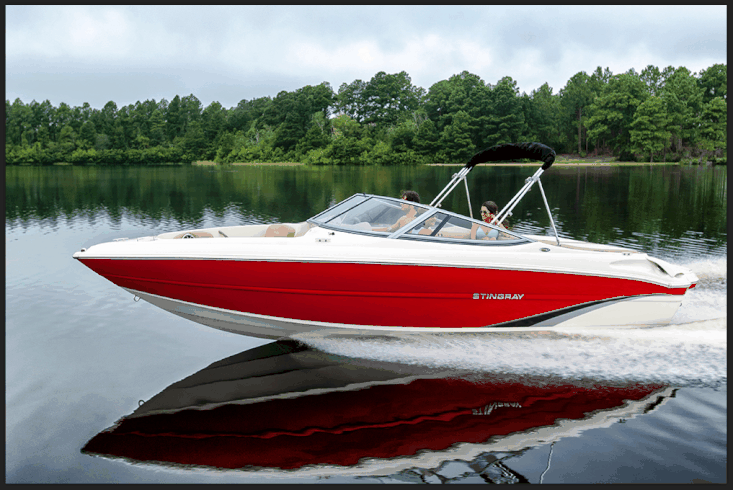
Stingray 225 LR